
 by
by Two on, one out, down two in the bottom of the eighth inning. Mitch Voit at the plate with a chance to give the Cyclones the lead.
“I love those big moments when it’s time to make a clutch play or a clutch at-bat,” Voit said. “It’s just something, growing up, I’ve always wanted to be in this situation, so when you get there, you’re excited, right? But you’re excited that you get the opportunity to go through your process.”
Voit swung through a curveball to open up the at-bat, and said he recognized basically the same pitch coming again, and drilled it over the left field wall.
“You don’t make that mistake twice,” Voit said. “And I was able to make him pay for it.”
The ball left the bat at 105 mph and landed 415 feet closer to Coney Island’s famous Cyclone roller coaster than it was just a few seconds prior. He raised his arm to his teammates in the first base dugout as he started his trot, and, in his own words, took his sweet time jogging the bases.

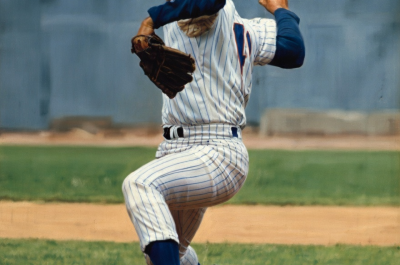
Like Mets draft picks Nolan McLean and Carson Benge before him, Voit is a former two-way player. He much more closely resembles Bench (McLean still did both for a few months as a Met), with both being former college pitchers who eventually gave it up to focus on hitting. It’s a parallel that Voit himself even recognizes.
“Guys like Benge, they really paved the way for people like me,” Voit said. “He did a great job as an example for every guy. He was a two-way coming in, and they drop one, and it’s like, here’s the path. Here’s what he did, extremely successfully, and obviously, that’s something I want to follow. But at the end of the day, I’m going to be on my own journey, I’m going to take everything day by day.”
Voit’s journey as a pitcher started when he was a kid, and he would practice pitching every single day. To hit, you need another person with you. To pitch, you can practice on your own.
“We had stairs that led up to my house,” Voit said. “My dad, he showed me the pitching mechanics and everything. And so I’d take a tennis ball, and you could ask the next-door neighbors, because they heard it. I would be out there as soon as I woke up, throwing a tennis ball against my stairs. And I’d do my whole pitching motion, and then I’d field the ground ball that came back after.”
For Voit, it was something he could do whenever he wanted. It was a way to pass the time doing something he loved.
He attended Whitefish Bay High School in Wisconsin, where he played third base and started once a week, which is the normal amount for a regular member of a high school rotation.
“Absolute bulldog on the mound,” Zach Hayes, a member of the Whitefish Bay coaching staff while Voit was there, said. “Mitch never gave in. He obviously had a great fastball and tremendous secondary stuff, but his ability to command the strike zone, his fearlessness, he would never, ever, back down.”
It can be difficult, Hayes said, to develop the routine you need to be as a pitcher while also being a regular fixture in the lineup. You need to regularly long-toss, throw bullpens, and establish an overall throwing routine while also getting all the swings and fielding reps you need to be a position player.
“Not everyone can handle something like that,” Hayes said. “It took someone with a special work ethic, and someone who wanted to live in the field and put in extra time whenever he had the opportunity to be able to maintain a schedule where you’re not taking on one thing like most players, you’re really taking on two, even three different things at the same time.”
He was recruited as a two-way player and attended the University of Michigan, where he played three seasons for the Wolverines.
Voit primarily operated with a three-pitch mix: A fastball, curveball, and cutter. He said he didn’t have overwhelming velocity, but he had control. And for a stint, a kick-change expanded his mix to four.
“I will say, I came up with that experimenting,” Voit said. “Without seeing any Instagram Reels or anything to give me the idea.”
He mostly came out of the bullpen as a freshman and then joined the rotation as a sophomore, where he made 10 starts before he tore his UCL. Voit underwent internal brace surgery following the season, and that was the end of his pitching career.
Despite the injury, Voit returned on time for his junior year as a position player only. Pitching, medically speaking, was not even on the table. His recovery process would not have allowed him to return as a pitcher in 2025. So, after playing mainly third base as a freshman and first base, left field, and right field as a sophomore, he moved to second base full-time as a way to take it easy on his arm.
Offensively, he exploded. After putting up a .777 OPS as a Freshman and .945 OPS as a Sophomore, Voit hit .346/.471/.668/1.140 with 14 home runs, 17 doubles, four triples, and more walks than strikeouts in 56 games as a Junior.
“It frees up a lot of space in your mind, right?” Voit said. “Because when you go to bed at night, and you put your head on your pillow, you’re thinking about both aspects of the game, right? So eliminating that pitching really just allowed me to put all my focus into being a position guy, being a hitter.”
There is a history of former two-way players making significant gains when choosing to focus on one side of the ball. McLean took off as a pitcher shortly after dropping hitting, and Benge did so as a hitter. Even going further back in Mets history, Jacob deGrom, a former college shortstop, exploded once he started pitching full-time.
The same, obviously, held true for Voit.
His draft stock soared over the course of the college baseball season, and the Mets wound up selecting him with their first pick at No. 38 overall. Voit was the organization’s only selection in the draft’s first 101 picks.
“When you are splitting time on doing stuff, one of the sides might be affected,” Cyclones manager Eduardo Núñez said. “So when you focus just on one thing, we hope, and we expect he can move faster up the ladder as a position player.”
Voit’s going to be playing both second base and shortstop for the Cyclones. He fell in love with second base in 2025 after playing it consistently for really the first time in his life, but the Mets want to expose him to both middle infield positions as he develops.
Embarking on his first full season as a professional baseball player, he’s excited.
“If I could play pro ball my whole life, I would,” Voit said. “But obviously that’s something you’ve got to earn.”